
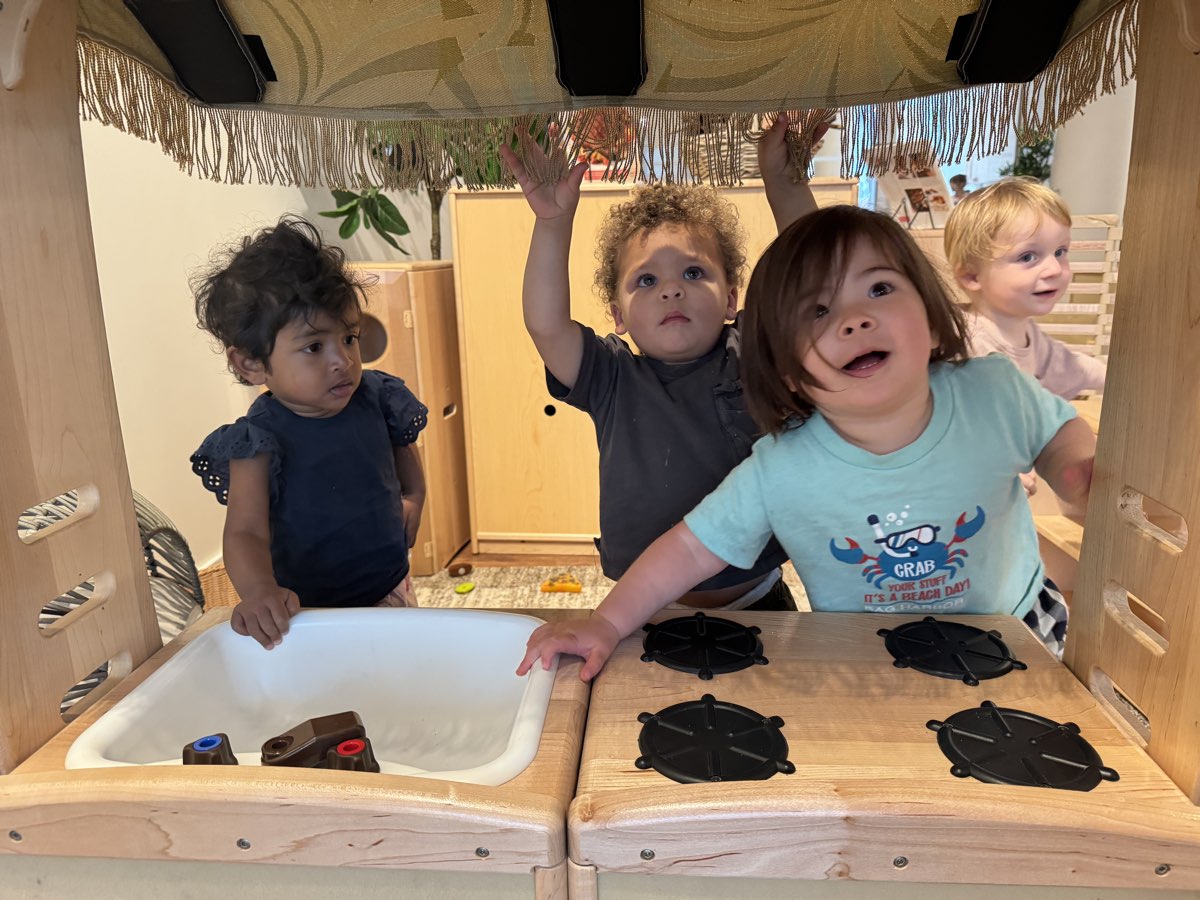
A look inside
Learning Spanish through play.
- Circle time each morning. Hellos, songs and what the day will bring, in Spanish.
- Stories and counting. Books read aloud and numbers counted, in Spanish.
- Art, sensory and discovery. Open every day. Spanish is the language of the room.
- Play, inside and out. Our indoor play garden daily, and outdoor time as well.
By age
Step by step.
- Infants and waddlers. Spanish is one of the three languages our babies hear.
- Toddlers. One of the three becomes their own, and Spanish is one of the choices.
- Preschool and Pre-K. The day happens in Spanish. In Pre-K, children start reading and writing in two languages.
Pick your child’s age to see their class.
At home
You do not have to speak Spanish at home.
They pick it up here, in songs, stories and play. What you speak at home stays strong.
The science
What the research says.
-
Babies are born ready.
A baby can hear the sounds of every language. That ear starts to narrow by the first birthday.
Source: University of Washington study -
It takes people, not screens.
In that study, babies learned from live speakers. Recordings did nothing. So our French, Mandarin and Spanish teachers spend part of every day in the baby room.
Source: University of Washington -
It will not confuse them.
Research shows more than one language does not confuse young children. The language you speak at home keeps growing.
Source: Zero to Three -
They already know their next teacher.
The teachers who sing to your baby today are the ones they move up to tomorrow.
Starting later
It is never too late.
Many of our children start at 1, 2 or 3. They do not have to start as babies to grow up bilingual.
Come see and hear it for yourself.
Pick a time. Bring your little one.
Book a tour